





Seplife 소개 ®이온 교환 크로마토그래피
How to use ion exchange chromatography resins?
1. Operation method:
Since the sample, buffer and eluent of biochemical separation are all mobile phases, they can be separated while flowing through the column. Therefore, ion exchange can be performed in column operation and separation in chromatographic form. During the separation process, the unadsorbed substances continue to flow out of the reaction system, which makes the balance shift to the right continuously, which is a kind of dynamic balance, so it is also called dynamic operation. The dynamic operation mode has good separation effect, is suitable for all kinds of samples, and can realize continuous operation. In the operation of chromatographic separation, the loading condition of the chromatographic column has a certain influence on the separation. The resins should be evenly distributed in the column, the existence of air bubbles is not allowed, and the stratification of the resins should also be prevented.
For some samples with high viscosity, the "static" treatment method can also be used for preliminary extraction and separation. The ion-exchange resins and the working liquid to be treated are stirred in the reaction vessel. When the adsorption equilibrium is reached, separate the resins and the raffinate and load them into a column for elution.
This static batch operation method has simple process equipment and easy operation. For example, the preliminary separation of some natural products such as heparin sodium often adopts this static separation method.
In the operation of static separation mode, the stirring speed of the ion exchanger in the working fluid should be properly controlled. If the stirring speed is too fast and the shear force is too large, the ion exchange particles will be broken and it will be difficult to filter and separate; If the speed is too slow, it will affect the contact between the resins and the working fluid, and also affect the exchange rate.
2. The impact of the sample on the separation effect:
In order to achieve high resolution and high load capacity for biochemical separation, the preparation and performance of the working solution are also very important factors. The viscosity and clarity of the working fluid not only affect the separation effect of the ion exchange resins, but also affect the service life of the separation medium.
Biochemical separation is often a relatively complex system, in which there are many kinds of impurities, not only small molecules, but also some colloidal substances, lipid substances, etc. In particular, some irreversibly adsorbed macromolecules can cover the functional groups of the medium, or block the pores of the medium, causing irreversible contamination and shortening the service life of the separation medium. Therefore, before the separation operation, the working fluid should be properly pretreated as much as possible to ensure the separation effect.
In the process of biochemical separation and purification, some target products are taken away by the elution process, or the target product is retained on the medium due to incomplete elution, resulting in product loss, which is an important factor affecting product yield.
At the same time, structural changes in the protein cause inactivation, which will also affect the yield. Adding some stabilizers or protective agents in the ion exchange process can not only increase the yield, but also improve the selectivity of the separation medium for proteins.
3. The impact of flow rate on the separation effect:
In ion exchange chromatography separation, the flow rate is an important factor affecting the separation effect. In order to obtain an excellent separation effect, experiments should be carried out based on factors such as the type of ion exchange resin, particle size, and molecular structure of the active ingredients in the working fluid to establish better experimental parameters.
If the molecular weight of the target product is relatively small and the pore size of the medium is relatively large, a higher flow rate can be used because it is conducive to mass transfer.
However, when the target product is a biomacromolecule, and the pore size of the medium is smaller than that of the separated substance molecule, a slower flow rate should be adopted due to the slower diffusion rate of the molecule.
When the viscosity of the working fluid is high, a lower flow rate should also be used due to the lower mass transfer rate.
The flow rate not only affects the effect of exchange adsorption, but also affects the effect of elution. Usually, the flow rate during elution is slower than that during the ion exchange adsorption.
4. The elution methods of Ion exchange chromatography:
When the target protein in the sample is completely bound to the ion exchanger, it should be eluted. The basic principle is to use an ion or group that is more active than the adsorption substance to desorb the target product that is exchanged and adsorbed to the outer surface and interior of the medium particle. Different target proteins have different binding abilities to ion-exchange resins. Therefore, a suitable eluent should be selected to elute the protein from the medium and collect the separated and purified products. There are roughly three elution methods for ion-exchange chromatography:
1) Simultaneous elution: The eluent is the same substance, and dilute acid, alkali or salt solution can be used, or an appropriate organic solvent can be used, among which salt solution is the main one, and the choice is made according to the properties of the target product and the dosage form of the final product.
Since the adsorbed substances are often not of a single type, the charges carried by various substances are different, and the binding strength with the medium is different. Even if the same eluent is used, the easily replaced substances will flow out of the medium first, and the binding force will be stronger. After the substances flow out, as long as they are collected by classification, various substances can be separated to obtain relatively pure products.
This method is mostly used for the separation when the properties of the target product are well known, or for the separation of analytical kinds.
2) Stepwise elution: that is, elution is carried out with different concentrations of salt solutions. During the exchange adsorption process of the separation medium, various proteins are adsorbed. If a constant elution condition is used, sometimes all the components cannot be properly separated, and the elution condition needs to be changed.
The change can be a staged change meaning different eluents or eluents with different pH values are selected for elution in stages, and different elution peaks can be obtained according to different concentrations and different acidities of the eluent. That is, one kind of salt concentration can get a kind of target protein, and different salt concentration can get different target proteins.
This step-by-step elution method is suitable for the separation of proteins with known properties, especially for large-scale production, and is easy to operate and control.
3) Gradient elution, that is, changing the ionic strength or pH value of the eluent according to a certain linear change (generally only in special cases, the elution method of changing the pH value is used). During the gradual change of the eluent, different proteins can be replaced one by one, and various protein components can be obtained.
At the same time, proteins generally do not tail. Gradient elution is the most commonly used elution method in ion exchange chromatography, and it is also the elution method with the strongest elution ability, which is suitable for the elution of components with similar charge properties.
In the elution process, both co-current elution or counter-current elution can be used. In co-current elution, the flow direction of the eluent is the same as that of the working fluid. In counter-current elution, or reverse elution, the flow direction of the eluent is opposite to that of the working solution.
If the feed liquid is exchanged and adsorbed through the exchange column from top to bottom, the concentration of the adsorbate in the upper layer of the exchange column is higher than that in the lower layer, and the reverse desorption of the eluent from bottom to top can achieve the purpose of elution more efficiently. However, since the operation of reverse elution is much more complicated than that of co-current elution, co-current elution is mostly used now.
이온 교환 크로마토그래피 수지의 소독:
높은 순도가 요구되는 일부 생화학 제품의 제조 과정에서는 미생물과 같은 불순물이 최종 제품에 혼입되는 것을 방지하기 위해 분리 매체를 멸균해야 하는 경우가 많습니다.
고온 소독은 가장 일반적으로 사용되는 방법입니다. 현재 대부분의 이온 교환기는 안정적인 물리화학적 특성을 가지고 있어 고온 소독에 견딜 수 있습니다. 그러나 다당류 매체를 사용할 경우, 반드시 염형 매체여야 하며, 고온 소독은 중성 조건에서 수행해야 합니다. 그렇지 않으면 다당류 고분자 구조가 분해되어 매체의 수명에 심각한 영향을 미칠 수 있습니다.
수산화나트륨(NaOH) 또한 우수한 소독제입니다. 다만, NaOH의 적절한 농도는 매질의 알칼리 내성 및 미생물 오염의 종류와 정도에 따라 선택해야 합니다. NaOH 소독 시에는 컬럼 침지법을 함께 사용할 수 있습니다. 즉, 일정 농도의 NaOH 용액을 컬럼에 통과시킨 후, 액체 배출 밸브를 닫고 수 시간 동안 침지시켜 소독 효과를 얻을 수 있습니다. NaOH를 에탄올과 함께 사용하면 더욱 좋은 소독 효과를 볼 수 있습니다. NaOH 소독 시에는 소독과 현장 세척(CIP)을 병행할 수 있습니다.
이온 교환 크로마토그래피 수지의 보관:
모든 종류의 크로마토그래피 수지는 사용 후 보관하기 전에 세척해야 합니다. 이는 특히 다당류 분리 매체에 있어서 매우 중요합니다.
분리 매체를 사용한 후에는 2CV의 물로 세척하고, 이어서 20% 에탄올 용액 2베드 부피를 통과시키십시오. SP 강산성 양이온 매체의 경우, 0.2mol/L 아세트산나트륨이 함유된 20% 에탄올 용액으로 세척한 후, 탈기된 에탄올-물 용액으로 더 느린 유속으로 세척하십시오.
처리 후에는 실온에서 보관하거나 4~8°C에서 장기간 보관할 수 있습니다. 수분 휘발 및 컬럼 건조를 방지하기 위해 보관 중에는 크로마토그래피 컬럼을 완전히 밀봉해야 합니다.
당분간 사용하지 않는 매질은 20% 에탄올 용액에 보관해야 합니다. 모든 이온 교환 분리 매질은 4°C ~ 30°C에서 보관하고 동결되지 않도록 해야 합니다.
이온 교환 크로마토그래피를 이용한 생체 고분자의 분리 및 정제 과정은 주로 다양한 분자의 해리, 이온의 순전하, 그리고 표면 전하 분포의 전기적 차이를 이용한 선택적 분리에 기반합니다. 이는 생화학 제품, 단백질, 펩타이드 및 기타 물질의 분리 및 정제에 가장 널리 사용되는 정제 기술 중 하나입니다.
세플라이프 ®덱스트란계 이온 교환 크로마토그래피 수지:
세프라이프 ® dextran ion exchange chromatography resins use the dextran matrix of G series gel filtration chromatography resins (Seplife G-25 and Seplife G-50), and the ion exchange functional ligands of different properties are firmly bonded to the cross-linked dextran matrix.
Dextran ion exchange resins are usually stored in the form of dry powder, which must be swollen before use. It is widely used in low molecular weight proteins such as prothrombin and low molecular weight heparin.
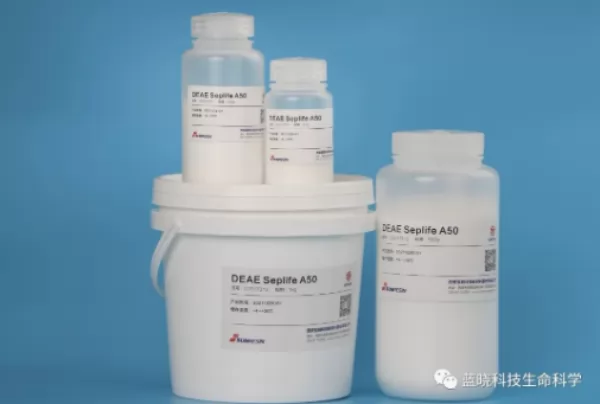
Sunresin’s dextran ion exchange chromatography resins:
DEAE Seplife ® A25/A50
Q Seplife ® A25/A50
CM Seplife ® C25/C50
SP Seplife ® C25/C50
Seplife ® Ultra-Fast Flow Agarose-based Ion Exchange Chromatography Resins (BB):
This series of Seplife ® ion-exchange chromatography resins are prepared by bonding ion-exchange ligands to agarose microspheres with a particle size of 100-300um. The back pressure is relatively small at the flow rate. For samples with high viscosity and turbidity, the use of this series of resins can improve the efficiency.
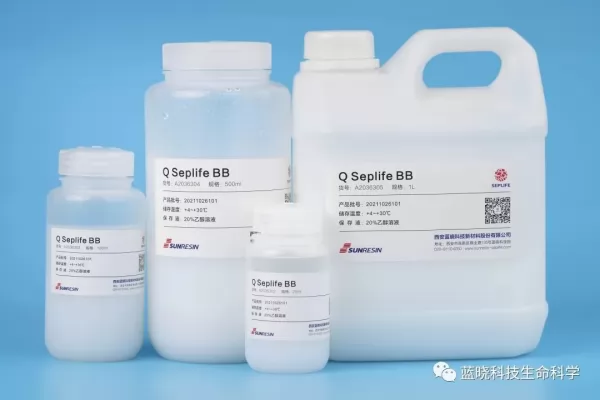
Sunresin’s Ultra-fast flow rate agarose ion exchange chromatography resins:
DEAE Seplife ® BB
Q Seplife ® BB
CM Seplife ® BB
SP Seplife ® BB
Seplife ® Fast Flow Agarose-based Ion Exchange Chromatography Resins (FF):
This series of Seplife ® resins use 45-165um agarose microspheres as the matrix, bonding with different functional groups. The suitable particle size range allows it to have a wider application range. It is widely used in various stages of capture, intermediate purification and polishing of biological products.
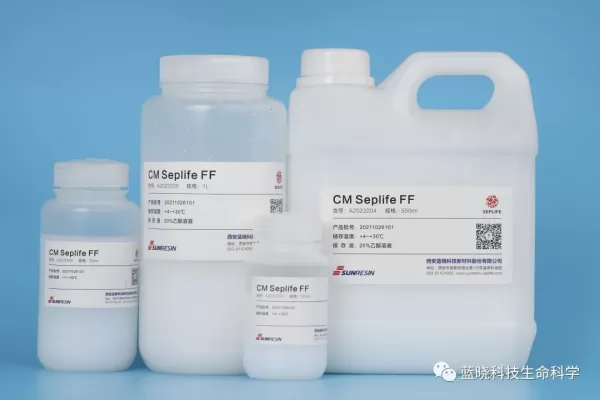
Sunresin’s Fast Flow Agarose ion exchange chromatography resins:
DEAE Seplife ® FF
Q Seplife ® FF
CM Seplife ® FF
SP Seplife ® FF
Seplife ® High Resolution Agarose-based Ion Exchange Chromatography resins (HP):
This series ses 25-45um agarose microspheres as the matrix and is prepared by bonding different functional groups.
The small particle size allows the resins to have higher resolution, and it is widely used in fine separation and preparation of small amount of samples.
_1698305485_WNo_600d400.webp "DEAE Seplife HP")
Sunresin’s High Resolution Agarose ion exchange chromatography resins:
DEAE Seplife ® HP
Q Seplife ® HP
CM Seplife ® HP
SP Seplife ® HP
Ultra High Capacity Agarose Ion Exchange Chromatography Resins (XL):
The special "tentacle" design on the agarose microspheres reduces the influence of steric hindrance when binding to biomolecules, and the ligands are more reasonably distributed, giving it ultra-high loading and very cost-effective.
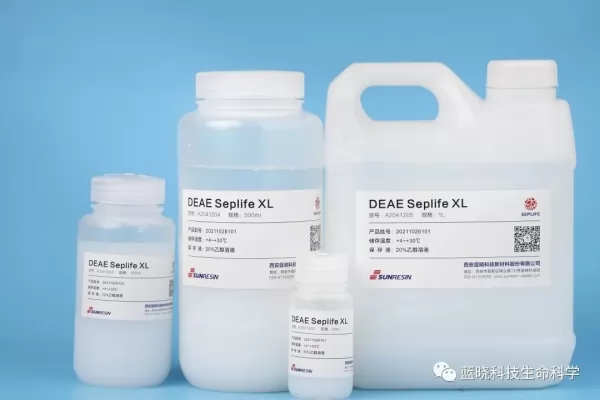
Sunresin’s Ultra High Capacity agarose ion exchange chromatography resins:
DEAE Seplife ® XL
Q Seplife ® XL
CM Seplife ® XL
SP Seplife ® XL
Seplife ® High Rigidity Agarose Ion Exchange Chromatography Resins (Large Scale):
Sunresin’s high-rigidity (Large Scale) agarose ion exchange medium has a maximum pressure resistance of 0.5 MPa, a maximum flow rate of 1000 cm/h, and a faster mass transfer rate, allowing a significantly improved efficiency for large-scale production.
According to the particle size of the matrix, Sunresin’s high rigidity agarose ion exchange medium is divided into high rigidity + high flow rate medium (Large Scale) and high rigidity + high resolution medium (Large Scale HP).
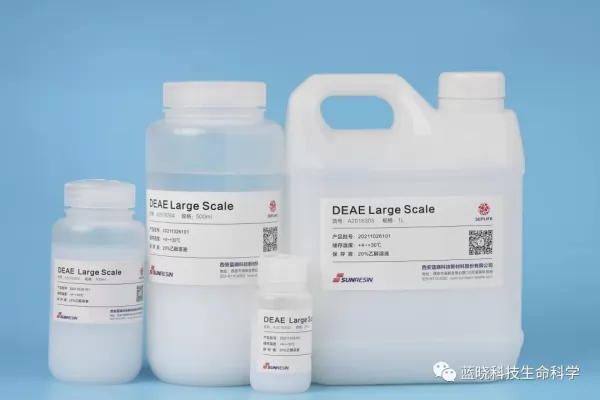
Sunresin의 고강성 아가로스 이온 교환 크로마토그래피 수지(대규모):
DEAE 대규모 /HP
Q 대규모 /HP
CM 대규모/HP
SP 대규모 /HP
세플라이프 ® 균일 입자 크기의 폴리스티렌 이온 교환 크로마토그래피 수지(LXMS):
세플라이프 ®IEX LXMS형 이온 교환 크로마토그래피 수지는 50nm, 150nm의 두 가지 기공 크기와 15, 30, 50μm의 세 가지 입자 크기를 가진 균일한 입자 크기의 폴리스티렌 수지를 제공합니다. 높은 가교 특성으로 인해 이 수지는 3MPa의 높은 작동 압력을 견딜 수 있습니다.
50nm와 150nm의 두 가지 기공 크기는 항체, 단백질, 펩타이드, 핵산, 항생제, 천연물 및 기타 분자량이 다양한 제품의 포획, 중간 정제 및 정밀 정제에 적용할 수 있습니다.
선레진의 균일 입자 크기 폴리스티렌 이온 교환 크로마토그래피 수지:
세플라이프 ® LXMS 15Q/15S (입자 크기 15μm, 기공 크기 50nm)
세플라이프 ® LXMS 30Q/30S (입자 크기 30μm, 기공 크기 50nm)
세플라이프 ® LXMS 50Q/50S (입자 크기 50μm, 기공 크기 100nm)
세플라이프 ® LXMS 50HQ/50HS (입자 크기 50μm, 기공 크기 150nm)
세플라이프 ® 폴리메틸아크릴레이트 이온 교환 크로마토그래피 수지(LXPM):
이온 교환 크로마토그래피 수지 제품군은 선레진의 독자적인 고분자 합성 기술을 이용하여 폴리메타크릴레이트를 기질로 하는 마이크로스피어 형태로 제조되었습니다. 이 마이크로스피어는 정밀한 기공 형성 기술과 표면의 친수성 장쇄 고분자로 개질되었으며, 다양한 이온 교환기와 결합되어 있습니다.
이온 교환 크로마토그래피 수지는 우수한 친수성, 화학적 및 물리적 안정성, 그리고 견고한 구조 덕분에 생체 적합성과 수명이 뛰어나며 정제 효율을 향상시킵니다. 항체, 단백질, 펩타이드, 핵산, 항생제, 천연물 등의 분자 포획, 중간 정제, 정밀 정제 등 생산 및 정제 단계 전반에 걸쳐 적용 가능하며, 고객에게 생물학적 시료의 산업적 생산을 위한 종합적인 솔루션을 제공합니다.
Sunresin의 폴리메틸아크릴레이트 이온 교환 크로마토그래피 수지:
세플라이프 ® LXPM CM/DEAE/SP/Q 650M (강한 친수성, 입자 크기 80μm) )
세플라이프 ® LXPM CM/DEAE/SP/Q 650S (강한 친수성, 입자 크기 50μm) )
세플라이프 ® LXPM CM/DEAE/SP/Q 706 (강한 소수성) ,강한 이온성 다중모드, 입자 크기 80μm )
세플라이프 ® LXPM CM/DEAE/SP/Q 5504 (강한 소수성 ,고해상도, 강력한 이온성 다중모드, 입자 크기 80μm)
다양한 종류의 이온 교환 크로마토그래피 수지에 대한 자세한 정보는 (info.lifescience@sunresin.com)으로 문의해 주십시오.
문의하기


